


Surha Tal: India’s 100th Ramsar Site
Syllabus: GS3/Environmental
Context
- Jai Prakash Narayan Bird Sanctuary (Surha Tal) in Ballia, Uttar Pradesh, has been designated as India’s 100th Ramsar Site.
About
- Established in 1991, the sanctuary is centred around Surha Tal, a natural perennial oxbow lake formed by the shifting course of the Ganga River.
- It is located in the Indo-Gangetic Plain, near the confluence of the Ganga and Ghaghara rivers.
- It hosts several migratory birds from Siberia and Central Asia, including the Greylag Goose, Pintail, Common Teal, and Bar-headed Goose.
- Local species include Sarus crane, Heron, and Cormorant.
Ramsar Convention
- The Ramsar Convention on Wetlands was signed in Ramsar, Iran, in 1971 and came into force in 1975.
- India became a signatory on 1 February 1982.
- There are over 2,500 Ramsar Sites worldwide.
Source: AIR
Isobutanol
Syllabus: GS3/Science & Technology
Context
- As India expands its biofuel strategy beyond ethanol, the government is evaluating the use of diesel blended with up to 15% isobutanol to reduce dependence on crude oil imports.
About
- Isobutanol is an alcohol-based biofuel that can be blended with diesel as an alternative fuel.
- It has a higher energy content and combustion characteristics closer to conventional hydrocarbon fuels, resulting in better fuel efficiency and a smaller impact on vehicle mileage than ethanol.
- It absorbs less moisture from the atmosphere, reducing storage and fuel-system challenges.
- It is less corrosive to fuel-system components, pipelines, and storage infrastructure.
- It can be used with relatively fewer modifications to existing engines and fuel distribution networks.
Source: India Today
Jan Samarth Portal
Syllabus: GS2/Government Initiatives
Context
- The Jan Samarth Portal has completed four years of promoting digital financial inclusion and seamless credit delivery.
About
- Launched in 2022, Jan Samarth is a single-window digital platform for availing benefits under 16 credit-linked government schemes.
- It facilitates access to institutional credit across sectors such as agriculture, business, housing, renewable energy, and livelihoods.
- Available in 8 languages, the portal has onboarded 269 lending institutions, including banks, NBFCs, and cooperative banks.
- It enables end-to-end digital loan processing with real-time verification through databases such as UIDAI, UDYAM, AgriStack, GST, and Central Board of Direct Taxes.
Source: PIB
Tax-Free Government Bonds for Foreign Investors
Syllabus: GS3/ Economy
Context
- The Government of India has abolished capital gains tax and withholding tax on Foreign Institutional Investors’ (FIIs)/Foreign Portfolio Investors’ (FPIs) investments in government securities with effect from April 1, 2026.
Key Provisions
- Foreign investors will no longer be required to pay;
- A 12.5% long-term capital gains tax on government bond investments.
- A 30% short-term capital gains tax on government bond investments.
- Withholding tax on interest income earned from government securities.
- The tax exemptions will apply to both foreign institutional investors and the Bank for International Settlements (BIS).
Reasons Behind the Decision
- The measure aims to attract larger foreign capital inflows and strengthen India’s debt market.
- The measure aims to support the rupee, bridge the projected Balance of Payments (BoP) deficit, and enhance external sector stability amid weak foreign investment inflows.
Key Economic Terms
- Long-Term Capital Gains (LTCG) Tax: A tax levied on profits earned from the sale of government securities held for more than 12 months.
- Short-Term Capital Gains (STCG) Tax: A tax imposed on profits earned from the sale of government securities held for 12 months or less.
- Withholding Tax on Interest Income: A tax deducted at source on interest earned by non-resident investors from government bonds.
Source: IE
India’s GDP Growth at 7.7% in FY 2025–26
Syllabus: GS3/ Economy
Context
- The Ministry of Statistics and Programme Implementation (MoSPI) has released the Provisional Estimates of GDP for FY 2025–26, showing that India’s economy expanded by 7.7%, higher than the earlier estimate of 7.6% and significantly above the 7.1% growth recorded in FY 2024–25.
Key Highlights
- Manufacturing-led Expansion: The manufacturing sector recorded a robust growth of 10.7% in FY 2025–26.
- Strong Performance of Services Sector: The sector comprising trade, repair, hotels, transport, communication, broadcasting, and storage grew by 11% in FY 2025–26.
- Consumption-led Growth: Private Final Consumption Expenditure (PFCE), a key measure of household spending, grew by 7.7%.
- Rise in Investment Activity: Gross Fixed Capital Formation (GFCF), an indicator of investment and asset creation, grew by 8.2%.
Factors Supporting Growth
- Structural Reforms: Continued implementation of economic reforms improved productivity and business efficiency.
- Strong Domestic Demand: Rising consumption expenditure boosted demand for goods and services. Growth remained largely driven by domestic economic fundamentals rather than external demand.
- Capital Expenditure Push: Government-led infrastructure spending strengthened investment momentum. Capital expenditure generated multiplier effects across manufacturing, construction, and services sectors.
About Gross Domestic Product (GDP)
- GDP is the total monetary value of all final goods and services produced within a country’s domestic territory during a specific period (usually a quarter or a year).
- Released By: National Statistical Office (NSO), Ministry of Statistics and Programme Implementation (MoSPI).
- Base Year: 2022–23.
- Calculation of GDP: GDP is calculated using three main methods;
- The Expenditure Approach: This method sums up all spending on final goods and services in the economy.
- The Income Approach: This method sums all incomes earned by factors of production (labor, capital).
- The Production/Value-Added Approach: This method adds up the value added by each industry at every stage of production.
Source: AIR
District Domestic Product (DDP) Estimates with Base Year 2022-23
Syllabus: GS3/Economy
Context
- The National Statistics Office (NSO), Ministry of Statistics & Programme Implementation (MoSPI) has uploaded the Draft Guideline for Compilation of District Domestic Product (DDP) Estimates with Base Year 2022-23.
About
- The guideline provides a comprehensive and uniform framework for compilation of District Domestic Product estimates across States and Union Territories.
- Objective: To ensure consistency, comparability and methodological standardization in district level economic estimates under the revised base year framework.
District Domestic Product (DDP)
- DDP estimates are statistical measures used to calculate the total value of goods and services produced within a district over a specific period.
- They serve as a disaggregated counterpart to the Gross State Domestic Product (GSDP) at State level and the Gross Domestic Product (GDP) at the national level, providing granular insights into the local economic structure and performance of districts
- They are useful for comparing economic performance between districts, identifying backward regions and planning local development programs.
Source: PIB
100 Years of solar data traces new clues on how the Sun’s surface tracks its 11-Year Activity Cycle
Syllabus: GS3/Science and Technology/Space
Context
- The Kodaikanal solar observatory, known for the oldest continuous series of solar data collected in India, provided insights for future solar cycle prediction.
About
- The energy generated within the Sun is transported through its outer layers via convection.
- Convective cells lead to the formation of small-scale granulations and large scale supergranulations as a network structure on the solar surface.
- The network cells have an average lifetime of 24 hr, and a size of about 30,000 km., The width of the cooler intergranular lanes is about 6000 km.
- The origin of these supergranulations, their size, and what is their relation with the 11-year solar cycle is not known.
- A recent study from the Indian Institute of Astrophysics based on more than 100 years of data from the Kodaikanal Solar Observatory sheds some light on these questions.
- The findings suggest that supergranular properties, such as lane width and intensity, are influenced by local magnetic flux and solar activity levels.
- The analysis confirms that while no single latitude follows the solar cycle exactly, significant correlations exist at specific latitudes for different quantities.
- It highlights the importance of understanding these correlations for predicting solar activity.
Solar Cycle
- The solar cycle is the cycle that the Sun’s magnetic field goes through approximately every 11 years.
- The Sun is a huge ball of electrically-charged hot gas. This charged gas moves, generating a powerful magnetic field.
- Every 11 years or so, the Sun’s magnetic field completely flips. This means that the Sun’s north and south poles switch places.
- Then it takes about another 11 years for the Sun’s north and south poles to flip back again.
- The solar cycle affects activity on the surface of the Sun, such as sunspots which are caused by the Sun’s magnetic fields.
- As the magnetic fields change, so does the amount of activity on the Sun’s surface.
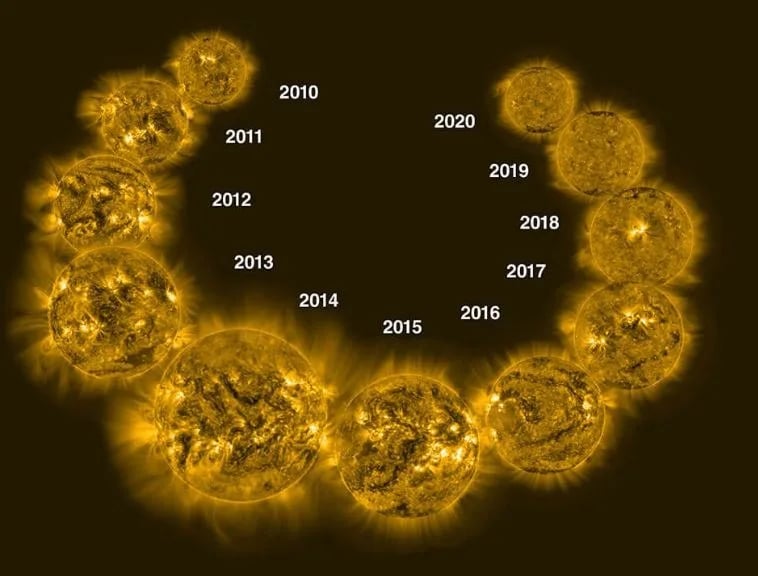
- Tracking of Solar Cycle: One way to track the solar cycle is by counting the number of sunspots.
- The beginning of a solar cycle is a solar minimum, or when the Sun has the least sunspots.
- Over time, solar activity and the number of sunspots increases.
- The middle of the solar cycle is the solar maximum, or when the Sun has the most sunspots.
- As the cycle ends, it fades back to the solar minimum and then a new cycle begins.
- Forecasting: Astronomers use many different ways to forecast the strength of the next solar cycle.
- This includes theoretical calculations based on dynamo models, extrapolations, precursor methods, etc.
- The precursor method uses the value of some measure of solar activity at a specified time to predict the strength of the following solar maximum.
Source: PIB
Previous article
India’s Approach To Biodiversity Conservation
Next article
8th India-Indonesia Joint Commission Meeting
